Transferring Endocrine Medical Records to a Thai Care Team
A record transfer is complete only when the receiving team has the material it needs in a usable form. A written scan report, the image files and a translation are separate items. Giving each its own status makes a missing file easier to find before the next appointment.
Inventory the originals before creating a summary
Samitivej’s medical-record and visit-preparation pages distinguish records from imaging materials. Its published processes are provider-specific, including different arrangements for some imaging files. Ask the actual services what they can release and receive rather than assuming that every item can be sent in the same way.
List the document type, date and source. Preserve laboratory units, reference intervals and the original language. A short summary can point the clinician to a report, but should not replace it with a new interpretation. Keep an amended report identifiable so the team can tell which version it has. [1] [2]
For a handover spanning countries, read Moving Between Countries: Organizing Endocrine Care Records
Separate requested, sent, received and readable
Ask the releasing and receiving services about their actual authorization, identification, format and secure-transfer requirements. One hospital’s published lead time or delivery method is not a nationwide rule. Record the agreed route and any material still being prepared.
A sender’s completed action and the recipient’s confirmation are different evidence. Mark a report “sent” when that is all you know. Mark it “received” only after confirmation, and ask whether it can be opened when readability is important to the visit. None of these stages means a clinician has already reviewed the content. [1]
One packet can contain several different statuses
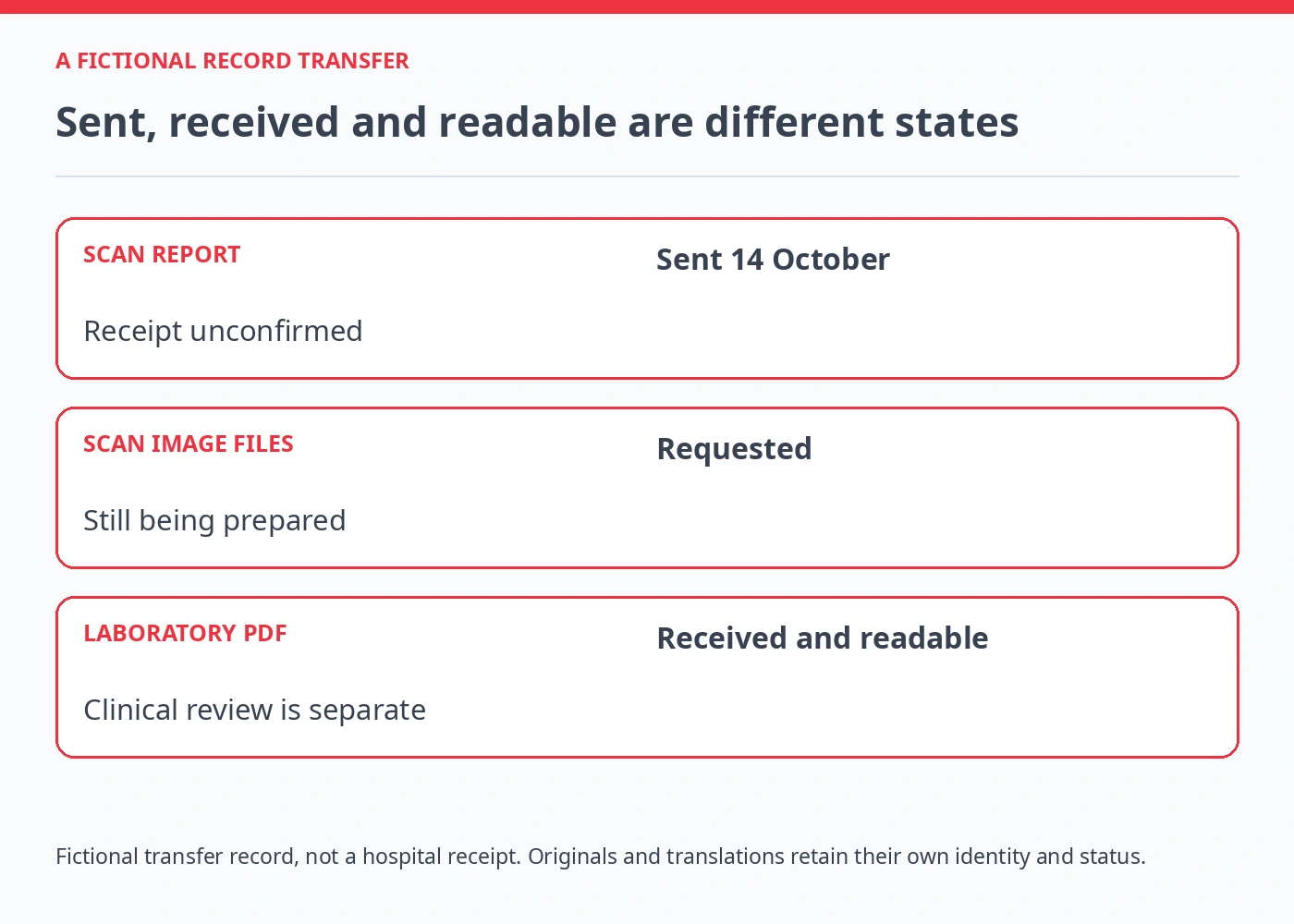
This fictional transfer record illustrates communication stages, not a universal hospital procedure.
| Item | Example status | Next clarification |
|---|---|---|
| Written scan report | Sent 14 October; receipt unconfirmed | Ask the receiving service to acknowledge it |
| Actual scan files | Requested; still being prepared | Confirm format and transfer route |
| Laboratory PDF | Received and readable | Clinical review remains a separate stage |
| Original-language document | Available | Retain beside any translation |
| Translation | Not yet arranged | Confirm what the receiving service requires |
A single “sent” tick would hide the missing images
In the fictional transfer, the written scan report has left the first hospital, while the image files have not. The receiving team has confirmed a separate laboratory PDF but has not acknowledged the scan report. Calling the packet “received” would collapse three different situations into one.
A useful follow-up names the specific item: “Please confirm whether the written scan report is readable; the image files are still pending from the earlier provider.” That lets the team explain whether anything needs to happen before the appointment.
Keep translations attached to their source documents
UK guidance distinguishes translating a document from interpreting a conversation. If a translation is needed for the receiving service, ask what standard it requires and identify the translator and status. Do not label a translation certified unless that has actually been established. Keep the original with it.
When the team confirms receipt, update only the relevant row. A complete transfer record can still show an item awaiting clinical review or a later file pending delivery. This approach coordinates the handover without inventing a diagnosis, changing a laboratory result or promising that another service will accept every document. [3]
Assign responsibility for results still pending after transfer using Planning Follow-Up When You Receive Endocrine Care Away From Home
Receipt is not the same as clinical review
No universal Thai fee, waiting period, consent form or translation requirement is asserted. Confirm the current process with the actual services involved.
Sources and reading context
- Samitivej medical records — Provider-specific records process; no universal fee, timing or consent rule
- Samitivej medical-history preparation — Provider-specific records and imaging preparation, not universal Thai intake requirements
- UK language interpreting and translation guide — Communication principles only; NHS rights and free-service rules are not Thai entitlements