Finding Official Channels for Suspected Medicine Side Effects in Thailand
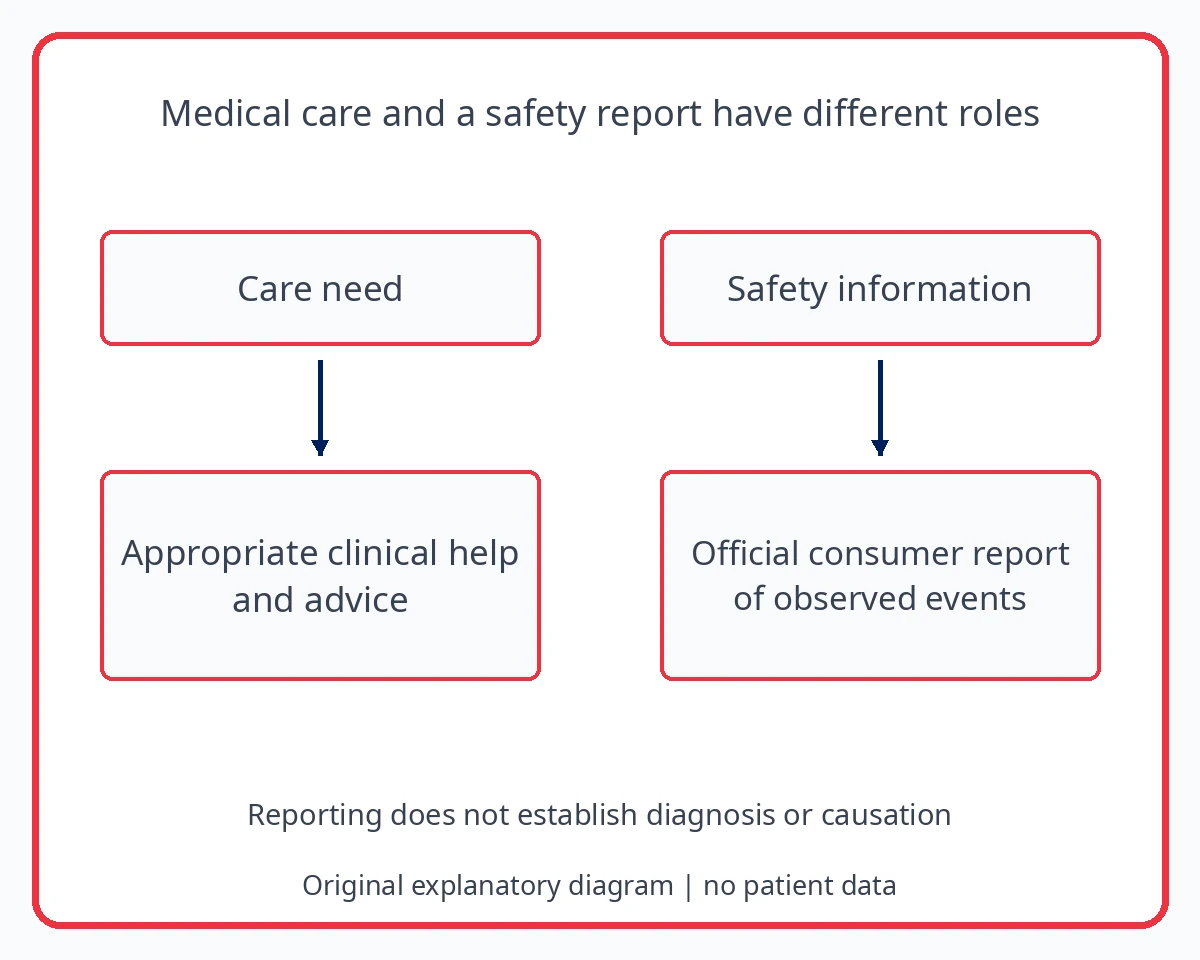
A medicine safety report is most useful when it preserves what happened and what remains uncertain. Record the event, timing and exact product without turning “happened after” into “was caused by.” Keep seeking appropriate care separate from the task of submitting information to Thailand’s HPVC.
Start from the official consumer-reporting entry
The Thai Health Product Vigilance Center provides a consumer-reporting entry that links to its public adverse-event form. The form groups information about the reporter, affected person, event and health product. Use the official route for personal information, rather than placing identifying medical details in a public comment or sales conversation.
The linked online form is in Thai. HPVC’s forms directory also lists English and Thai versions of consumer Form 2, but a directory listing alone does not guarantee a working English download or submission route. If language or access is a barrier, seek help through the official service or a healthcare professional; do not guess the meaning of a field. [1] [2] [3]
Describe the sequence without deciding the cause
The consumer form asks for event details, dates, outcome and product-use information. Write what was actually observed, retain approximate dates as approximate and identify information you do not know. The date a symptom was first noticed may differ from its true onset. Do not invent a more precise sequence to make the account look complete.
HPVC describes collection, assessment and investigation as parts of its safety work. A report contributes information to that process; submission does not itself establish that a medicine caused the event. Keep any advice received from the healthcare team separate from your observation and from the reporting record. [2] [4]
Preserve the observation and the reporting status
All dates and events in this example are fictional. This is an organizing aid, not a reproduction of the official form.
| Item | Example status | Next clarification |
|---|---|---|
| Product use | Started 3 June, according to the available record | Preserve exact product identity separately |
| Observed event | Symptom first noticed 5 June; earlier onset uncertain | Describe the symptom without a causal conclusion |
| Care contact | Healthcare team contacted 6 June | Record the advice actually received separately |
| Cause | Not established | Sequence alone does not decide it |
| Report | Notes prepared; no submission confirmation available | Do not invent a reference or completed submission |
A report reference does not turn the sequence into a diagnosis
In the fictional record, product use begins before the symptom is noticed. That timing is relevant information, but the account still leaves the cause unresolved. The record should not be rewritten as “the product caused the symptom” merely because a report is later submitted.
If the official service provides a submission reference, keep it with the reporting record. It documents that reporting step, not a diagnosis, a treatment instruction or confirmation that the submitted details were clinically assessed. The care team’s actual advice belongs in a separate note.
Keep the exact supplied product identifiable using Getting Clear Information About a Prescribed Medicine in Thailand
For a clear suspected-event timeline, see Reporting a Suspected Medicine Side Effect: Building a Clear Timeline
Keep reporting and care on their own tracks
Record the current outcome and any later information accurately if the official process asks for it. Do not re-expose yourself to a product to try to make a report more convincing. An uncertain date or outcome is better represented as uncertain than replaced by a guessed answer.
A reporting form is not an emergency-care service and should not delay seeking appropriate help. This article organizes information for the official process; it does not diagnose the event, tell you to change treatment or promise a particular response from HPVC. Use the responsible care team for clinical instructions.
Safety reporting does not replace clinical care
This guide submits no report and gives no diagnosis or treatment advice. The reporting process must not delay urgent medical attention.
Sources and reading context
- Thai HPVC consumer reporting entry — Current consumer entry read and linked form inspected; not an emergency care route
- Thai HPVC consumer adverse-event form — Consumer form with reporter, affected-person, event and product information; a report is not proof of causation.
- Thai HPVC reporting forms directory — Lists Form 2 ENG/THAI; English file retrieval not verified
- Thai HPVC roles and surveillance — Collection and assessment of reports, not diagnosis or causality proof